
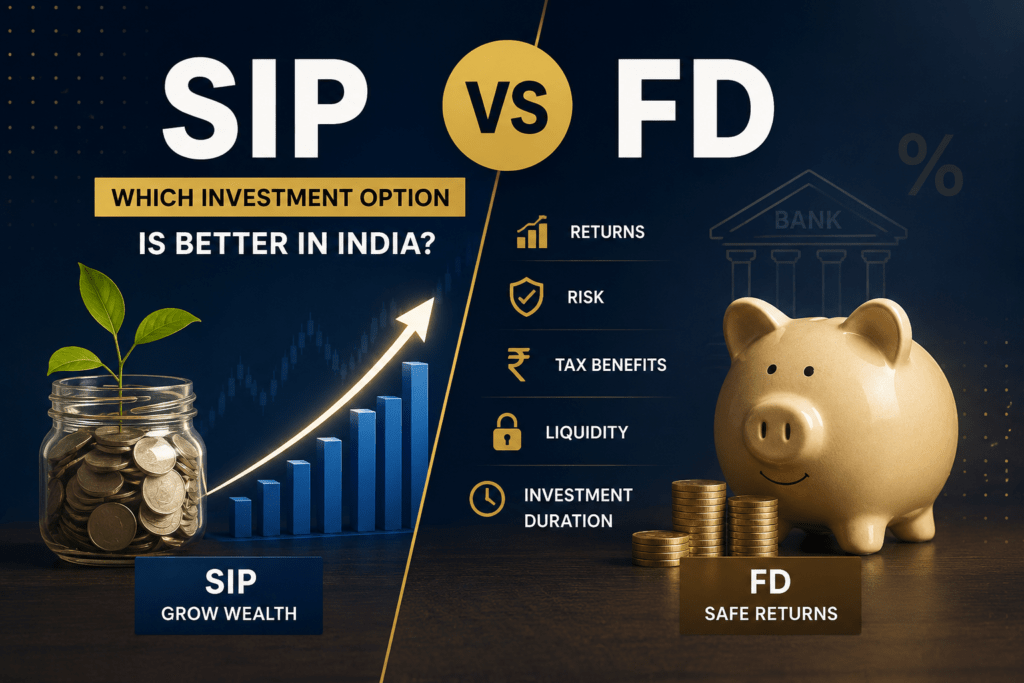
When it comes to investing money safely and growing wealth, two of the most popular options in India are SIP (Systematic Investment Plan) and Fixed Deposit (FD). Both investment methods have different advantages, risks, and return potential.
Choosing the right option depends on your financial goals, risk tolerance, and investment duration.
In this guide, we will compare SIP vs FD in detail to help you make a smarter financial decision.
What is SIP?
A SIP (Systematic Investment Plan) is a method of investing regularly in mutual funds. Investors can invest a fixed amount every month and benefit from market growth over time.
SIP investments are linked to the stock market, which means returns are not fixed but can generate higher long-term growth.
Benefits of SIP
- Higher long-term return potential
- Power of compounding
- Flexible monthly investment
- Inflation-beating growth
- Suitable for wealth creation
What is FD?
Calculate While You Read
Free calculators related to this article — instant results, no signup.
A Fixed Deposit (FD) is a low-risk investment offered by banks and financial institutions. You deposit a lump sum amount for a fixed period and earn guaranteed interest.
FDs are considered safer investments because returns are fixed and stable.
Benefits of FD
- Guaranteed returns
- Low risk
- Stable income
- Better for conservative investors
- Easy to understand
SIP vs FD Comparison
| Feature | SIP | FD |
|---|---|---|
| Risk | Moderate to High | Very Low |
| Returns | Market-linked | Fixed |
| Average Returns | 10%–15% | 6%–8% |
| Liquidity | Moderate | Moderate |
| Wealth Creation | Excellent | Limited |
| Inflation Protection | Better | Lower |
| Tax Efficiency | Better in ELSS | Taxable interest |
Which Gives Better Returns?
Historically, SIP investments in equity mutual funds have generated higher returns compared to fixed deposits over long periods.
For example:
- ₹5,000 monthly SIP for 15 years at 12% return can grow significantly through compounding.
- FD returns remain fixed and may struggle to beat inflation.
However, SIP returns are market-dependent and can fluctuate.
Who Should Choose SIP?
SIP is better for:
- Young investors
- Long-term wealth creation
- Retirement planning
- Investors comfortable with market fluctuations
Who Should Choose FD?
FD is suitable for:
- Senior citizens
- Conservative investors
- Short-term goals
- People looking for guaranteed returns
Is SIP Safer Than FD?
FD is generally safer because returns are guaranteed. SIP involves market risk but offers higher growth potential over time.
The right choice depends on your investment objective.
Final Verdict
If your goal is long-term wealth creation and beating inflation, SIP is usually the better option. If you prefer safety and guaranteed returns, FD may be more suitable.
Many investors also combine SIP and FD together for balanced financial planning.
Conclusion
Both SIP and FD are useful investment options with different benefits. Before investing, evaluate your financial goals, investment duration, and risk appetite carefully. A balanced strategy often works best for long-term financial growth.